
BiteBack
Lead Product Designer
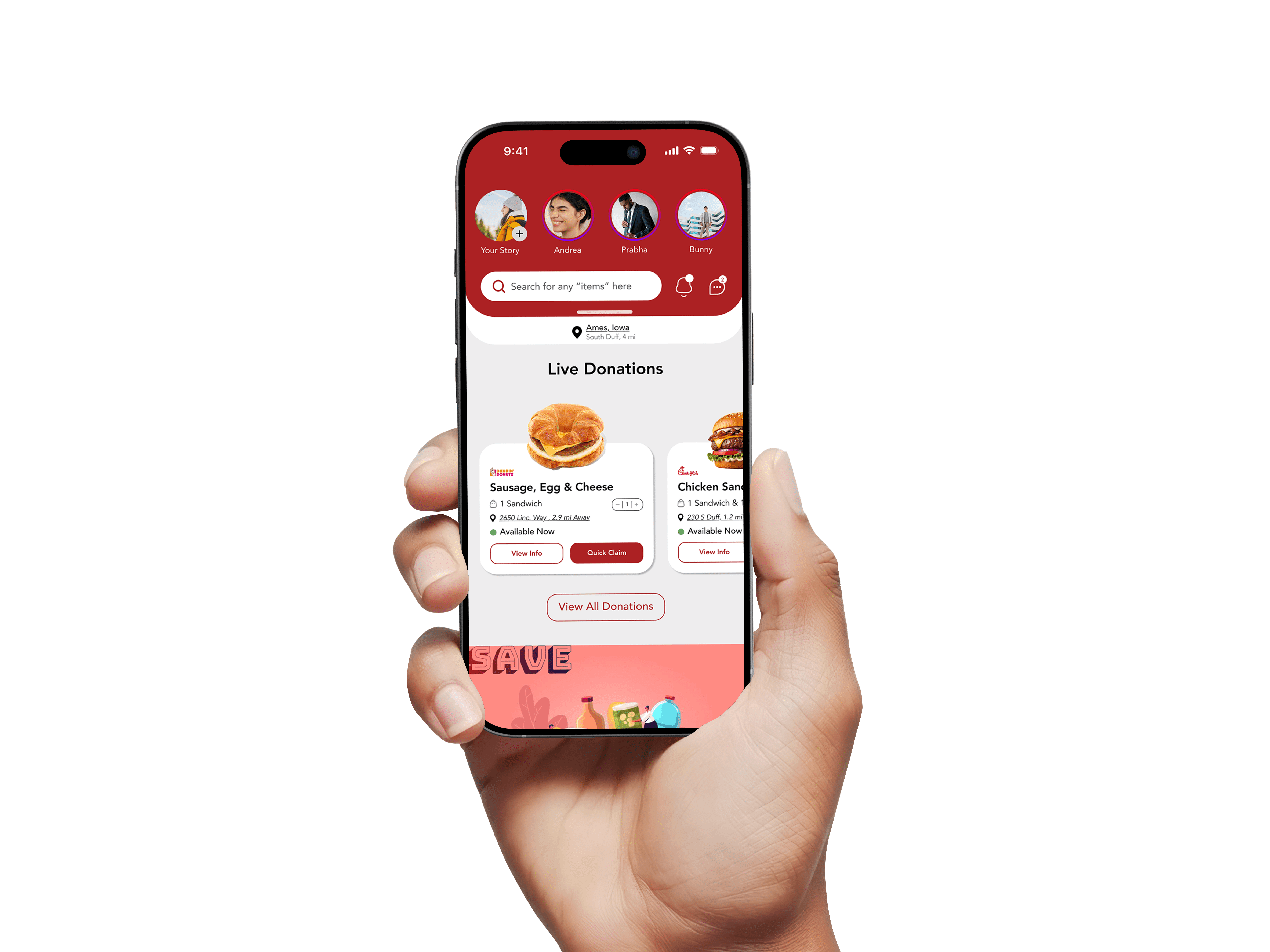
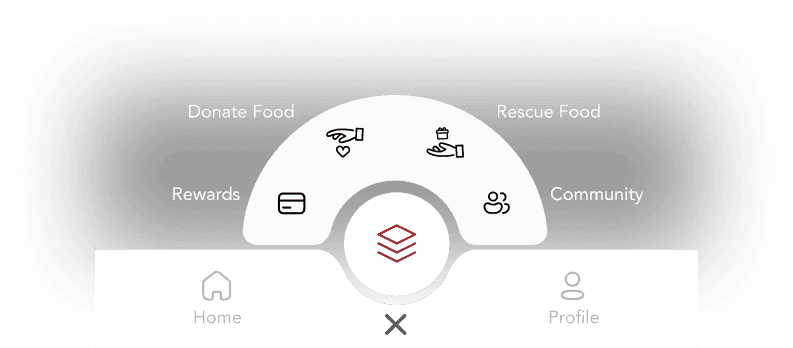
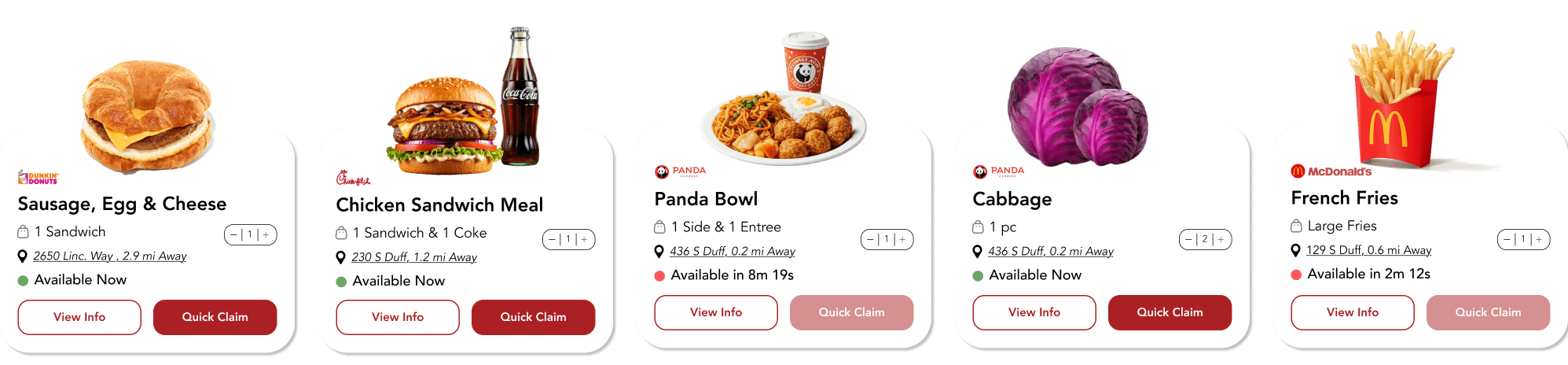
Quick Claim
Concept
Product Design
UX Research
Designing a real-time food redistribution
system.
A system that helps users discover surplus food instantly while enabling restaurants to donate efficiently, increasing food recovery and reducing waste.
TIMELINE
TEAM
TOOLS
Jan - March
2025
Me, 2 UX Researchers,
1 Graphic Designer
Figma, FigJam, Miro,
Taguette
MY ROLE
UX Researcher &
Product Designer
MY ROLE & CONTRIBUTIONS
UX Researcher & Product Designer
Led UX strategy and defined the core interaction model. Designed Quick Claim end-to-end and
owned the V2 high-fidelity design and prototype. Translated research into an action-first
experience, shaping product direction through usability testing and scalable product decisions.
PROBLEM & OPPORTUNITY
Millions of pounds of food wasted daily, while people struggle to access affordable meals.
Existing donation systems are fragmented, slow, and lack real-time visibility. There's no shortage of surplus — there's a shortage of connection.
No real-time, centralized platform. People rely on word of mouth or outdated listings.
Users can't find surplus food
Trust is low
Freshness and safety concerns prevent adoption. Users hesitate without quality signals.
Restaurants face friction
Logistics, liability, and time pressure make donation harder than disposal.
How might we create a real-time, trustworthy system that enables fast food
redistribution without increasing operational burden for restaurants?
THE CORE INSIGHT THAT CHANGED EVERYTHING
Users don't lose food because they
can't find it, they lose it because
they can't act fast enough.
This single realization shifted the entire product from discovery-first to action-first — and became the foundation of every design decision.
I identified this pattern during transcript coding and pushed the team to restructure the entire interaction model around it.
RESEARCH
What users and owners actually said
We interviewed 5 users and 2 restaurant owners. Separate protocols for each group. Transcripts coded in Taguette, synthesized through affinity mapping on Miro.
Two questions guided us:
How do users currently
find surplus food?
What prevents restaurants
from donating?
7 Interviews
Transcript Coding
Affinity Mapping
Personas
Journey Maps
Raw signals from interviews
These are real quotes from our Taguette-coded transcripts, the signals that drove everything.

User 1
GRADUATE STUDENT
"I think notification for food availability is a good option... probably you can just have the system turned off until the food is available... have a live location to the restaurant."
Users need real-time alerts, not static listings
"

User 2
GRADUATE STUDENT
"It is the topmost priority in the food category because freshness and quality is the main thing that everyone, whoever is having a food from a restaurant should consider."
Freshness is the #1 trust signal
"

Owner 1
RESTAURANT OWNER
"Pickup is a huge one, especially when you know we're already busy closing... it is kind of the last thing you want to do, load up this food, drive somewhere to go drop it off."
Pickup logistics are the #1 donation blocker
"

Owner 2
RESTAURANT MANAGER
"Having pickup or being able to schedule pickup is a huge one, I would say... easy listing, pickup, scheduling notifications and stuff like that."
Flexible scheduling is non-negotiable
"
FROM RESEARCH TO SOLUTIONS
The messy middle that most case studies skip.
We didn't jump from quotes to features. Here's the actual process: coding transcripts → finding themes → brainstorming solutions → categorizing by impact → prioritizing what to build.
1
Interviews
2
Coding
3
Synthesis
4
Brainstorm
5
Prioritize
6
Design
STEP 3 — AFFINITY MAPPING
We organized 70+ data points into 7 theme clusters
Using Miro, we grouped coded transcript highlights into themes across both user groups. Patterns emerged around speed, trust, logistics, and engagement.
Streamlined Navigation
Scheduling & Pickup
Community Engagement
Incentives & Rewards
Transparency & Notifications
Restaurant Integration
Food Safety & Freshness
STEP 4 — SOLUTION BRAINSTORMING
We generated 40+ solutions across both personas,
then categorized them
Each team member brainstormed independently for both Vanya (user) and Stella (restaurant owner), then we converged and classified every idea:
SPECIAL / DIFFERENTIATING
Quick Claim: one-tap reserve
for high-demand items
Real-time notifications for food availability
AI-powered food matching algorithm
Gamification: challenges and missions for points
Freshness indicators on every listing
Community impact digest: social feed with stories
Dietary preference filters
Restaurant POS system sync
Donation tracking with export reports
Flexible pickup scheduling for restaurants
Blockchain-based donation tracking
FOUNDATIONAL / ESSENTIAL
DISCARDED / NOT NEEDED
STEP 5 — FINAL SOLUTIONS SELECTED
6 Solutions prioritized based on both user needs
We evaluated each solution against user needs, feasibility, and strategic impact. I drove this prioritization framework, narrowing 40+ ideas into the 6 features we committed to designing and testing:
Quick Claim
One-tap reservation with 15-min pickup and QR verification.
01
Speed theme + User need
for instant action
Freshness Indicators
Prep time, category, dietary info, freshness countdown.
02
Trust theme + User #1
quote on quality
Community Digest
Social feed with impact stories and restaurant contributions.
03
Engagement theme +
Retention gap
Gamification
Missions, points, streaks, and leaderboards.
04
Incentives theme + Repeat use need
Flexible Pickup
Restaurant-set time windows for food collection.
05
Logistics theme + Owner #1
pickup quote
Donation Tracking
History, export, and impact reports for restaurants.
06
Transparency theme + Owner
need for visibility
PRODUCT STRATEGY
Four pillars, not a feature list.
Every decision in the product maps back to one of these.
PILLAR 01
Reduce
Time-to-claim
Quick Claim
PILLAR 02
Build Trust in
Quality
Freshness Indicator
PILLAR 03
Drive
Engagement
Digest + Rewards
PILLAR 04
Minimize Restaurant
Effort
Simplified Listing
SOLUTIONS
What I designed, and why?
Five features that survived prioritization. Each traces directly to a research signal.
A one-tap reservation system with a 15-minute pickup window and QR verification.
Quick Claim
01 . CORE
→ Speed theme + User need for instant action
Every listing shows preparation time, category, dietary info, and freshness countdown. Just enough to decide, not enough to hesitate.
Freshness Indicator
02 . TRUST
→ Trust theme + User #1 quote on quality priority
A social feed showing food saved, community stories, and restaurant contributions. Makes the mission visible and shareable.
Community Digest
03 . DIFFERENTIATOR
→ Engagement theme + Retention gap in research
Gamified challenges ("Rescue food 5 times this month"), redeemable points, visual streaks, and an invite-a-friend bonus. Every action earns something tangible.
Missions & Rewards
04 . RETENTION ENGINE
→ Incentives theme + Repeat user need from research
A streamlined listing wizard: name, photo, quantity, freshness, and pickup time, all done in seconds. Full donation history with export for tax records.
Donation Listing
05 . RESTAURANT SIDE
→ Logistics theme + Owner #1: "the last thing you want to do"
DESIGNING UNDER CONSTRAINTS
Real-world tradeoffs I navigated.
This wasn't just about usability, it required balancing speed, trust, and operational realities.
Instant claiming risks hoarding
I introduced time-bound reservations and QR verification. Users must pick up within 15 minutes, preventing abuse while preserving speed.
SPEED VS. MISUSE
More info builds trust but slows decisions
I prioritized only high-signal data — freshness and prep time, over exhaustive detail. Just enough to decide, not enough to hesitate.
TRUST VS. FRICTION
If listing takes too long, restaurants won't do it
I reduced the donation flow to seconds — name, photo, quantity, pickup time. No unnecessary fields. The fastest path to participation.
EFFORT VS. ADOPTION
Unclaimed food still leads to waste
Time windows and accountability mechanisms (QR codes, claim history) reduce drop-offs and keep the system honest.
NO-SHOWS VS. WASTE
WHAT DIDN'T WORK
The pivot that redefined the product.
INITIAL APPROACH
We prioritized browsing, assuming users wanted to explore before acting.
PIVOT
WHAT WORKED
Users didn't want to browse. They wanted to act. We shifted to action-first. This became the product's foundation.
I led the decision to deprioritize exploration and optimize the entire experience for speed.This reduced time-to-claim, improved completion rates, and aligned the product with real user behavior, not our initial assumptions.
VALIDATION
From usability to behavior change
We tested two iterations with the same group of users to understand not just usability, but how behavior changed when friction was removed and trust was introduced.
Browse-first → Action-first (Quick Claim)
Added freshness indicators to reduce uncertainty
Added freshness indicators to reduce uncertainty
WHAT WE OBSERVED
Users no longer hesitated before claiming food.
Faster decision-making
Validated the decision to prioritize speed over exploration
01
VERSION 1 BEHAVIOR
Users spent time evaluating listings before deciding to claim
VERSION 2 BEHAVIOR
Users claimed first and
reviewed details after,
aligning with real-world urgency
Users reported significantly higher confidence in food quality.
Increased trust → higher
willingness to claim
Trust became a conversion driver, not just a UX improvement
02
VERSION 1 BEHAVIOR
Users hesitated, asked questions, or abandoned listings lacking detail
VERSION 2 BEHAVIOR
Freshness indicators eliminated guesswork, users committed faster
Users completed tasks with less effort and confusion.
Reduced cognitive load
The system moved from "figuring out" → "acting instinctively"
03
VERSION 1 BEHAVIOR
Users got lost navigating, needed multiple attempts to find features
VERSION 2 BEHAVIOR
Navigation became predictable, actions became obvious, fewer steps needed
Users naturally explored beyond core tasks.
Strong engagement signals
The product evolved from a utility → habit-forming system
04
VERSION 1 BEHAVIOR
Users completed assigned tasks but didn't explore further
VERSION 2 BEHAVIOR
Users interacted with missions, rewards, and community digest unprompted
METRICS
SUS Score Improvement
"GOOD" → "EXCELLENT"
.
/7
Average SEQ Score
ALL USERS, ALL TASKS
%
Task Completion
HIGHER ACROSS ALL TASKS
The product crossed a critical threshold: from "usable interface" → "behaviorally aligned system"
Users didn't just complete tasks — they adopted the intended behavior:
Acting Quickly
Trusting the system
Engaging repeatedly
WHAT THIS MEANS
WHAT I WOULD VALIDATE NEXT (IF SHIPPED)
Claim conversion rate
Views → claims — are users acting on what they see?
Time-to-claim for high-demand items
Speed metric that directly measures Quick Claim's effectiveness
Repeat usage (weekly active users)
Are digest and missions creating real retention loops?
Restaurant retention rate
Are simplified flows keeping owners donating consistently?
Because success isn't usability — it's sustained behavior change at scale.
PRODUCT IMPACT
If this ships, here's how the business wins
Quick Claim and real-time alerts reduce the window where food goes unclaimed — directly increasing recovery volume.
Increase surplus food recovery
rate
Reduce restaurant disposal
costs
Every item claimed through BiteBack is one fewer item in the waste stream — saving disposal fees and creating tax-deductible donations.
Drive repeat engagement
through habit loops
Missions, streaks, and community digest create behavioral loops that bring users back weekly — the foundation of marketplace liquidity.
The success of BiteBack depends on marketplace liquidity — balancing supply (restaurants listing food) and demand (users claiming it). Every design decision was made to lower friction on both sides of this equation simultaneously.
WHAT I WOULD NEXT
If this shipped tomorrow
Scaling the system beyond prototype
AI demand prediction
Predict which food will go fast based on time, location, and behavior — enabling preemptive notifications.
Behavioral Notifications
Alert users based on claiming patterns, not just proximity.
Pickup route optimization
Route batching for users claiming from multiple locations.
University & food bank partnerships
Time windows and accountability mechanisms (QR codes, claim history) reduce drop-offs and keep the system honest.
MY REFLECTION
"This project shifted my thinking from
designing screens to designing systems."
BiteBack isn't just a mobile app, it's a coordination system between supply, demand, and time. The biggest lesson: the best features aren't the ones you add
— they're the friction you remove.
SHOE CARNIVAL
Not a Prototype.
A Real Mixed Realty Store.
Coming Soon
WHITE ELEPHANT
Wear It Before
You Buy It
Coming Soon